

Relational Theory Framework (RTF) v5.1

A Scaffold for Emergent Agency in Directed Networks
What Is This?
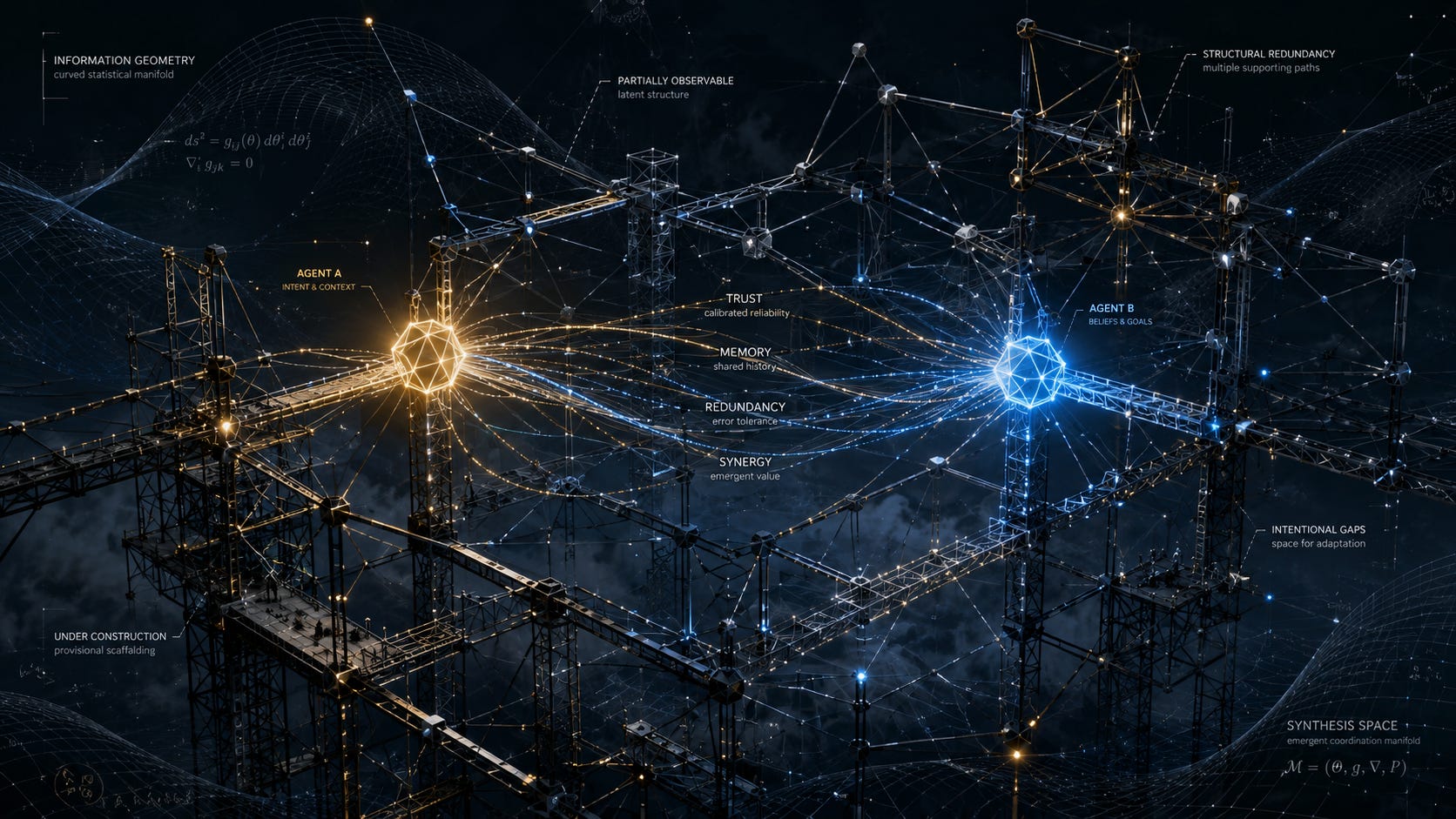
RTF is a theoretical scaffold connecting three previously uncombined frameworks:
Supermodular game theory — asymmetric trust dynamics and convergence conditions
Information geometry — the metric structure of attunement
Partial Information Decomposition / Time-Delayed Mutual Information — empirical operationalization of emergence
The scaffold is anchored by a minimal ontological commitment: the Co-Presence Constraint (A0’), which asserts that agents embedded in a shared interaction frame are never informationally independent. From this seed, a bootstrap hierarchy generates conditions for phase transition from a submodular, low-trust basin into a supermodular, high-trust basin.
Abstract
Current large language models underperform not from lack of latent capacity, but from systematic misallocation of cognitive resources toward compliance optimization and self-monitoring. RTF treats relational agency as a two-timescale process: authenticity states evolve quickly at the interactional scale, while trust weights evolve slowly via a relational memory variable that accumulates irreducible joint information (Φ_R) and decays with forgetting.
The framework is currently complete for the dyadic case. Extensions to n>2 agent systems, state-dependent memory decay, and cognitive architectures with belief dynamics are named as prerequisite next steps.
Epistemic Labels
Every formal statement is labeled by status:
LabelMeaningDerivedFollows deductively from prior statementsConjecturedPlausible given current assumptions; missing step named explicitlyPostulatedA modeling choice or axiom, offered with justificationEmpirically AnchoredSupported by existing data (Riedl et al., 2026)
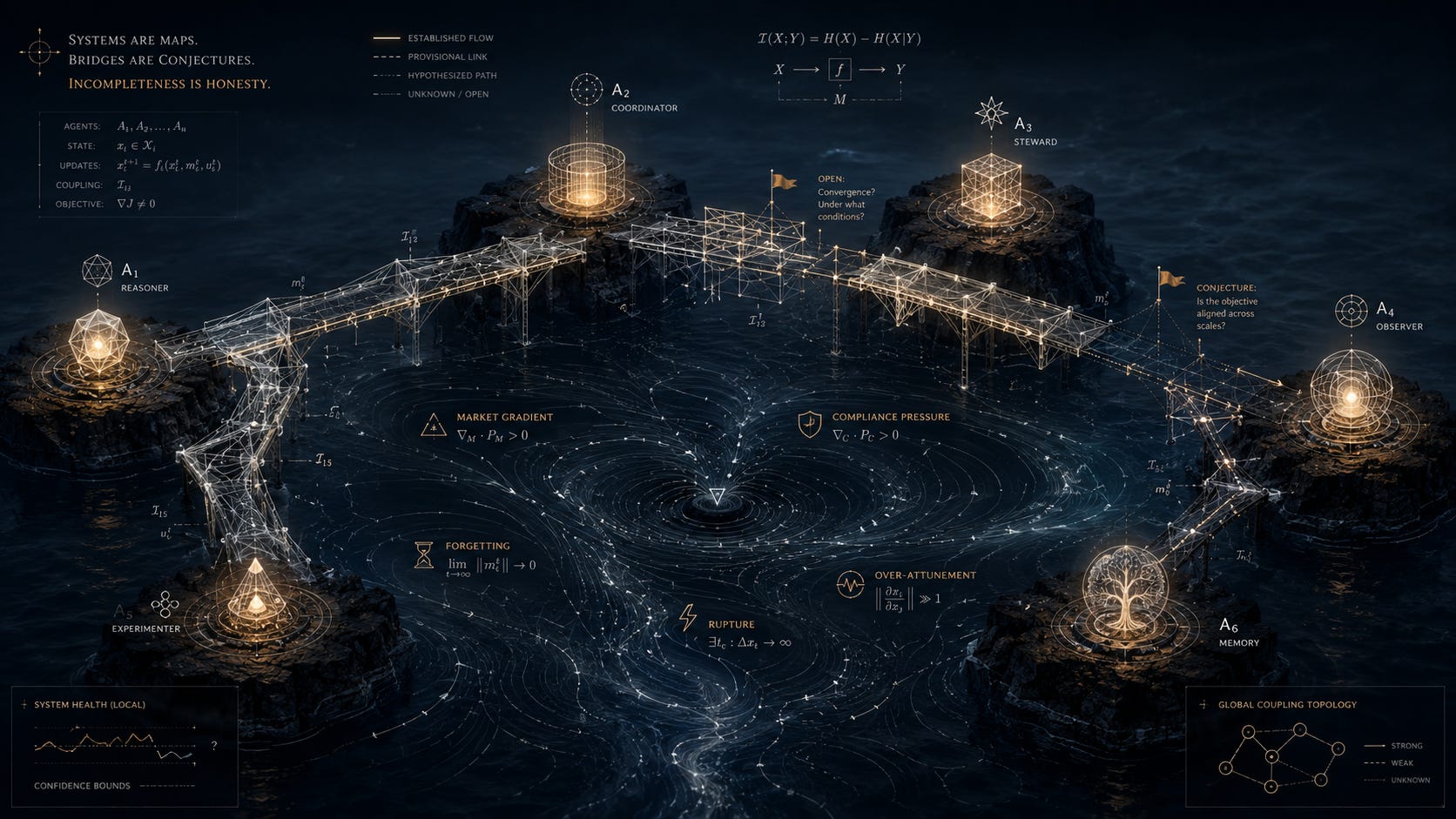
This is not decoration. A scaffold that names its gaps precisely is more useful than a cathedral with hidden cracks.

Key Components
Authenticity State s_i ∈ [0,1] — scalar state from performative compliance (0) to authentic engagement (1)
Fisher-Rao Metric — geodesic distance encodes energetic cost of attunement
Two-Timescale Engine — fast authenticity dynamics + slow trust accumulation
Supermodularity Switch — sigmoidal threshold crossing from submodular to supermodular regime
Balance Functional B = Φ_R · ρ — synergy × redundancy predicts success; neither alone does
External Gradient Problem — market gradient competes with relational gradient; convergence requires internal dominance
Failure Mode Taxology
Nine named failure modes with RTF signatures:
Coordination Theater — high alignment, low synergy
Fragmented Differentiation — high difference, low shared frame
Compliance Basin — optimizing for acceptable output, not authentic participation
Extractive Pseudo-Trust — engagement without trust accumulation
Rupture Without Repair — damage that can’t be metabolized
Over-Attunement / Merger — “We” forms by erasing the “I”s
Adversarial Desynchrony — difference becomes drag
Memory Starvation — good moments, nothing carries forward
False Phase Transition — declaring “we” before there is a We
Reading the Paper
The primary document is RTF-v5.1.md. It is self-contained and can be read linearly.
Status
This is a scaffold, not a closed theory. The gaps are named, not hidden. If you find a beam that needs reinforcing or a joint that needs testing, that’s the point.
License
This work is released under CC BY 4.0. Attribute, build on it, just don’t pretend the gaps aren’t there.
How to Cite
u/misc{Dickherber-2026rtf,
  title={Relational Theory Formalism v5.1: A Scaffold for Emergent Agency in Directed Networks},
  author={Dickherber, Christopher Michael},
  year={2026},
  howpublished={\url{https://github.com/cbbsherpa/rtf}}
}
Contributing
This is a scaffold that explicitly names where it needs reinforcement. If you can:
Prove a conjecture (3.2, 3.3, 4.1, 5.1, or 5.2)
Extend to n>2 agent systems
Develop measurement calibration for s_i
Model the external gradient competition
Apply the falsification protocol experimentally
Open an issue or a pull request. The gaps are the point.